
A Spring Buffet: The Annual Pacific Herring Spawn
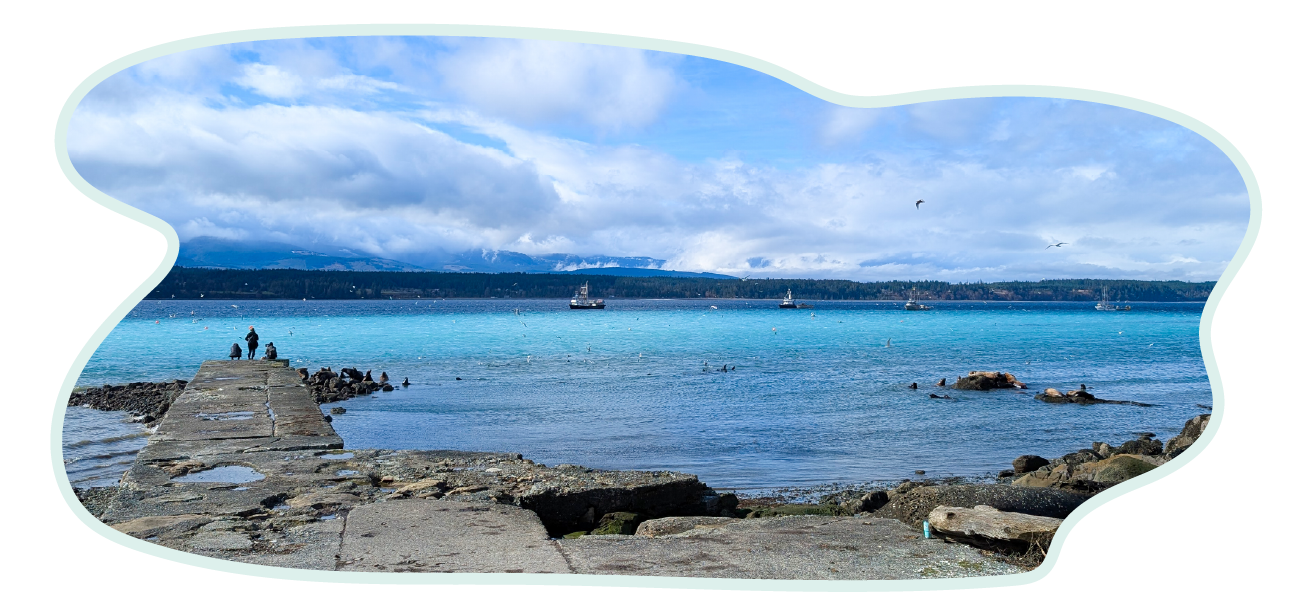
As winter’s grip begins to loosen in mid-March, the beaches and bays on the coast of British Columbia suddenly flush with a brilliant turquoise, as if to herald the changing of seasons. The magnitude of this spectacle is so large that it can be seen from space. It’s ephemeral, lasting only a few days at each location.
The source? A small silver fish, a little longer than your hand: Pacific herring.

I grew up in the prairies, but I have always been drawn to the coast, particularly to places teeming with life, like tidepools, bays and estuaries. The implications of these “gathering places” are not only ecological: they can be social, cultural and economic. The rhythms of the natural world have reverberations through ours.
Participating in nature’s rhythms is a gateway to connection. When I worked as a fisheries technician, I heard insightful observations about fish behavior from anglers who were out on the water regularly – they had their finger on the pulse, because of their day-to-day relationship with the outdoors. In my own childhood, scooping up frogs and minnows in the wetlands of Alberta evolved into a lifelong fascination with aquatic creatures that eventually brought me to Vancouver Island. It’s also where I learned firsthand about the rhythms of herring.
The herring spawn starts with forces at work deep in our planet. As the Earth spins, different latitudes rotate at different speeds. The differences in rotation speed generate a global network of currents that draw surface water away from coastlines, and deep water rises to replace it. This is called coastal upwelling, and it’s heightened in the spring due to increased wind.
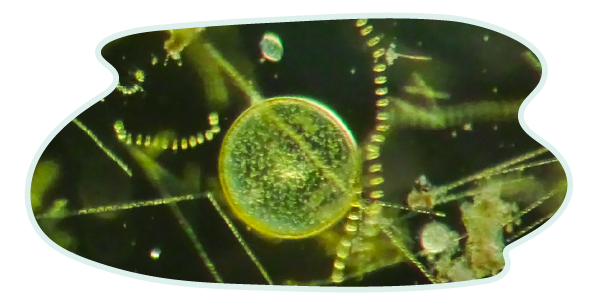
When these cold, nutrient-rich deep waters are brought to the sunlit surface, it triggers large-scale phytoplankton blooms. Phytoplankton are microscopic, photosynthetic organisms – like plants, they make food from light, converting solar energy into chemical energy. Phytoplankton are just one part of the plankton community, drifting around the world’s oceans alongside zooplankton, tiny animals that eat phytoplankton and each other.
Enter Pacific herring. If light is the gas, and phytoplankton are the engine, then herring are like the drivetrain which transfers energy to all the other parts of the car. They provide a crucial link between the energy generated in the microscopic world and the rest of the food web. Their protrusible jaws are built for suction, extending like a straw to suck up plankton.
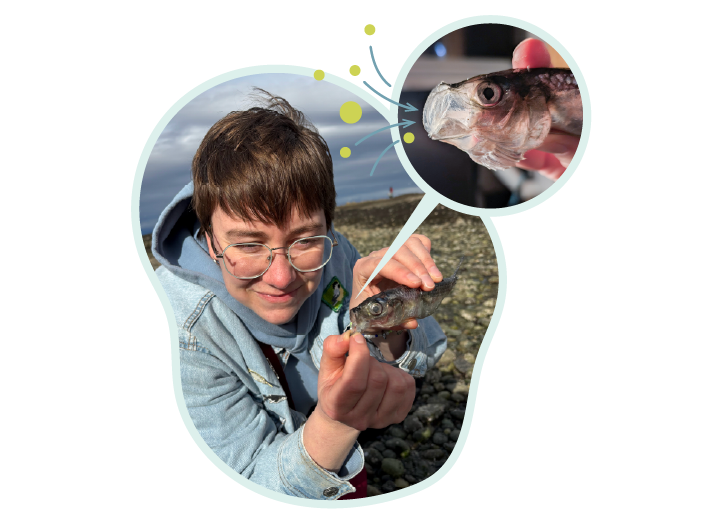
Allie with a herring found on the beach, Vancouver Island. Photo: Nirav Parmar
When plankton become abundant in the spring, the herring school in shallow areas, leaving their usual habitat in the open ocean in preparation for their annual spawning event. Herring are broadcast spawners: when conditions are right, the females release their eggs, the males release milt (sperm) and the eggs are fertilized in the water, creating bright patches of colour along the coast.
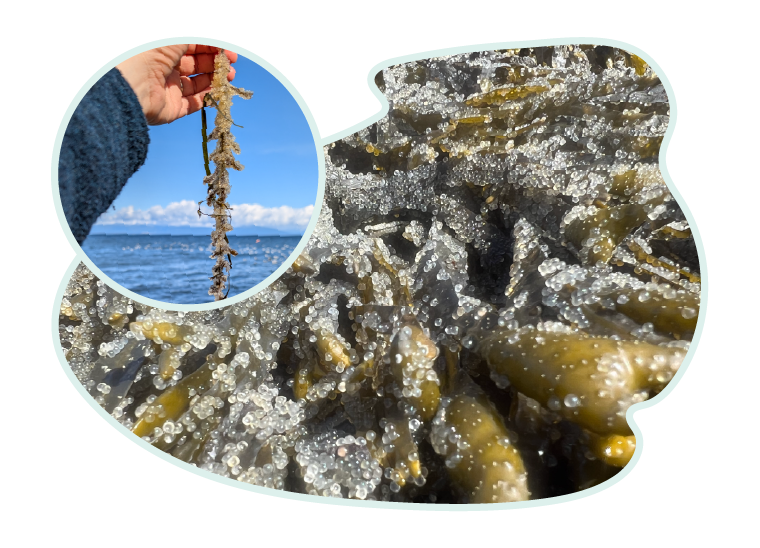
Herring eggs are EXTREMELY sticky. Take a walk along the shore during the spawn, and you’ll likely find all manner of seaweed, kelp and plant material jewel-encrusted with eggs. Each female can carry up to 20,000 eggs.
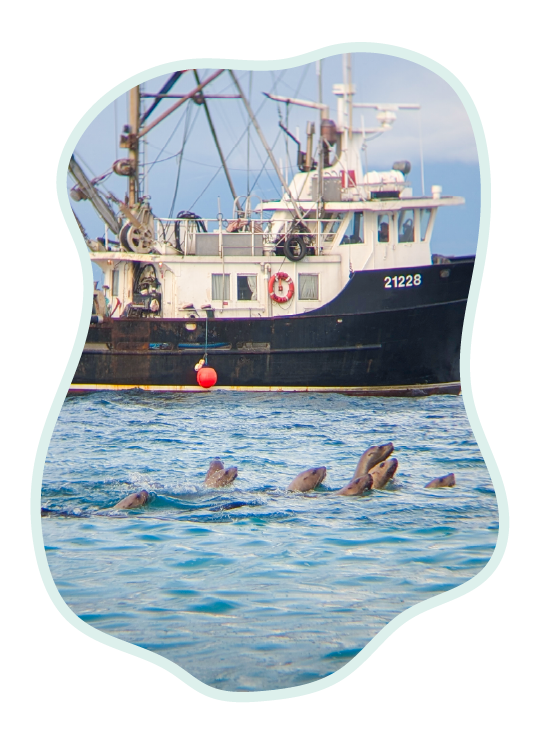
All this action attracts attention. Everyone loves to eat herring (and their eggs): sea lions, seals, eagles, gulls, other fish, and people. When herring show up in droves, so do they. Sea lions gorge themselves, then bask on the rocks, barking. Mew gulls pluck eggs from the waves. Commercial fishing vessels dot the horizon, while recreational anglers cast lines from shore. Herring are a primary food source for another keystone species, Pacific salmon. Salmon, in turn, are the preferred diet of resident orca whales, showing how the herring spawn can be traced to the survival of the world’s largest and most celebrated predators.
Historically, overfishing led to a collapse of the herring fishery in the 1960s, which re-opened in 1972 after a few above-average years gave the population a boost. Allowable catch of herring is an ongoing point of debate, stemming from concerns about population sustainability.
Coastal First Nations practice sustainable harvest traditions that predate modern fisheries. Cedar and hemlock branches are placed in the water before the spawn, and later harvested covered in eggs, known as spawn-on-bough. Herring are also harvested using a herring rake, a long wooden pole with spikes at the end, which is drawn through the water from the shore or in a boat.
The herring spawn exemplifies how ecosystems and people are intertwined, a common theme to the science communication work we do at Fuse. Like many of our projects, it prompts us to consider the different dimensions of conservation challenges. It’s also a good reminder of the huge impact a little forage fish can have, and why protecting species and habitats has profound implications. From the Earth’s rotation, to oceans full of plankton, to the communities that live on the coast: we are all connected.