
The mysterious migration of monarch butterflies
Monarch butterflies remind me of home. The dance of their bright orange wings across the sky has always drawn my sense of wonder, and growing up in Leamington, Ontario, I’ve been lucky enough to witness these insects at their most spectacular. Every fall, monarch butterflies decorate the trees as part of a remarkable migration event. It is truly a breathtaking sight!
Leamington is home to Point Pelee National Park, the southernmost point in mainland Canada. Its southern location makes it an important place for monarch butterflies to rest before they embark on their long journey south for the winter.
When the winds are right, thousands of butterflies congregate on trees near the peninsula at the southernmost part of the park, known as the Tip. Here, you can observe clusters of monarchs in the trees and flashes of bright orange as they fan their wings open and closed while resting on the branches.
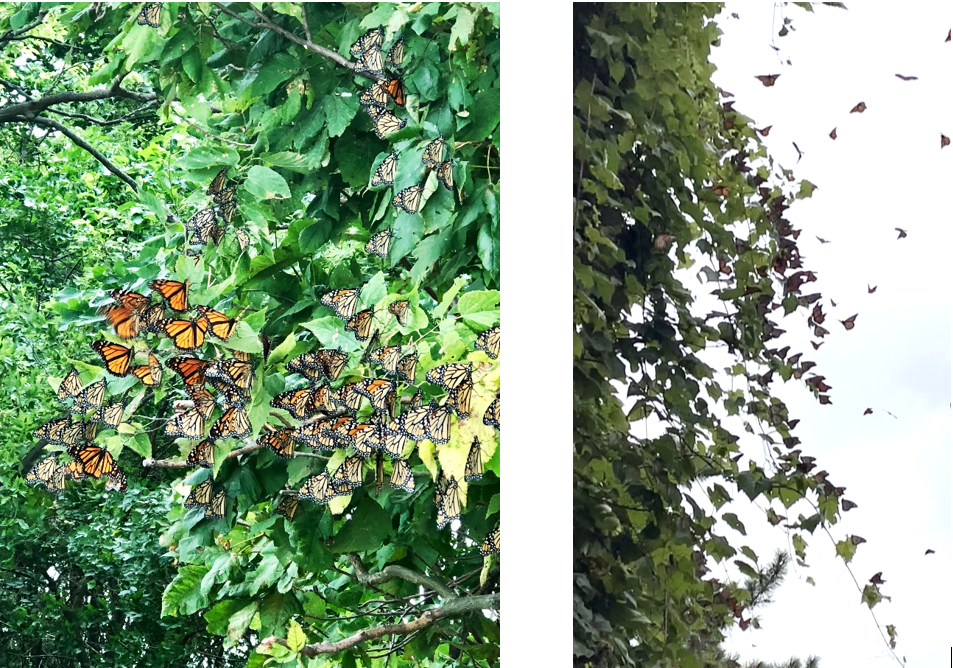
Monarch butterflies clustered in the trees in Leamington, Ontario.
Monarchs in North America are divided into eastern and western subpopulations based on their migratory routes. The eastern population, which I grew up witnessing at Point Pelee, migrates to the mountains of central Mexico to spend the winter. The western population migrates to overwintering sites along the California coast. Not a bad place to escape the harsh Canadian winters!
Remarkably, the eastern monarchs that return to Canada are not the same ones that left for Mexico. The monarchs that successfully reach and overwinter in central Mexico begin to move north in the spring. These monarchs begin laying eggs in northern Mexico and the southern United States before reaching the end of their lives. Their offspring then hatch and continue north, themselves laying eggs. Two more generations are produced this way throughout the summer, each spreading a little farther north. Towards the end of the summer, the final generation emerges across the northern United States and southern Canada. This is the generation I saw gathering at Point Pelee – the generation that will make the big journey back to Mexico. The journey from Point Pelee National Park to the overwintering sites in Mexico is roughly 3000 kilometres. That’s about the distance from Toronto to Vancouver – a far flight for a tiny butterfly!
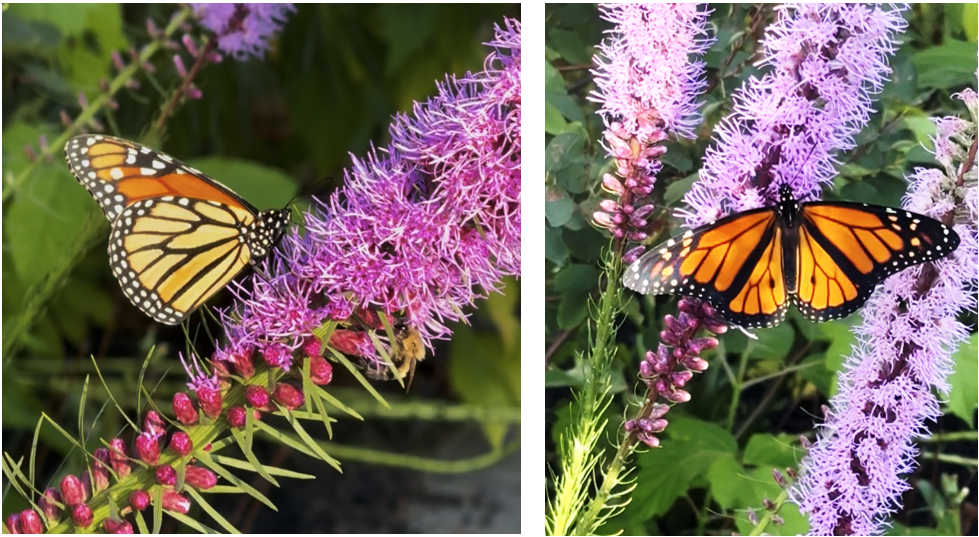
Without having ever been to Mexico themselves, these monarchs somehow navigate the journey south to the same mountain forests where countless monarch generations have overwintered before them. Scientists have found that monarchs use the sun as a compass, with circadian clocks in their antennae helping them navigate. They can also use the Earth’s magnetic field as an additional compass when sunlight isn’t available. But how they know exactly where they are going is still a mystery.
Unfortunately, monarch populations have declined in recent years. Monarch butterflies are officially listed as an endangered species in Canada. Threats to monarchs include the loss of breeding habitat and nectar sources, insecticide and herbicide use, and climate change and extreme weather events.
I still get excited every time I see a monarch. If you’d like to experience a little monarch magic for yourself, consider planting native milkweed and other local pollinator-friendly plants in your garden. Milkweed is the only plant monarch caterpillars eat and the primary plant on which monarchs lay their eggs. If you plant it, they will come!
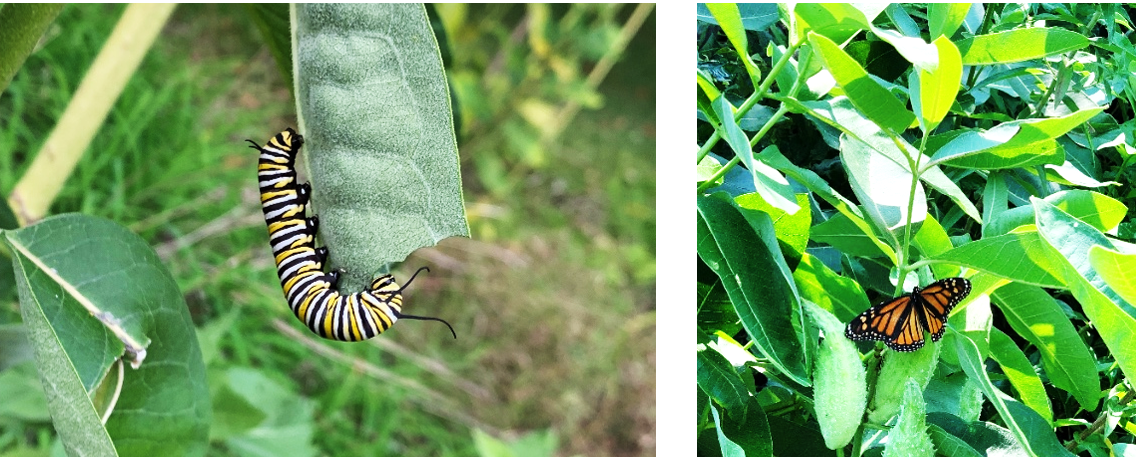
An adult monarch caterpillar eating milkweed (left) and an adult monarch butterfly resting on milkweed (right).
One day, I hope to stand in the mountains of central Mexico to witness the overwintering colonies and greet them after their long journey. No matter how much I learn about monarchs, they never seem to lose their sense of mystery.

Monarch butterfly artwork by Rachel Tiessen.